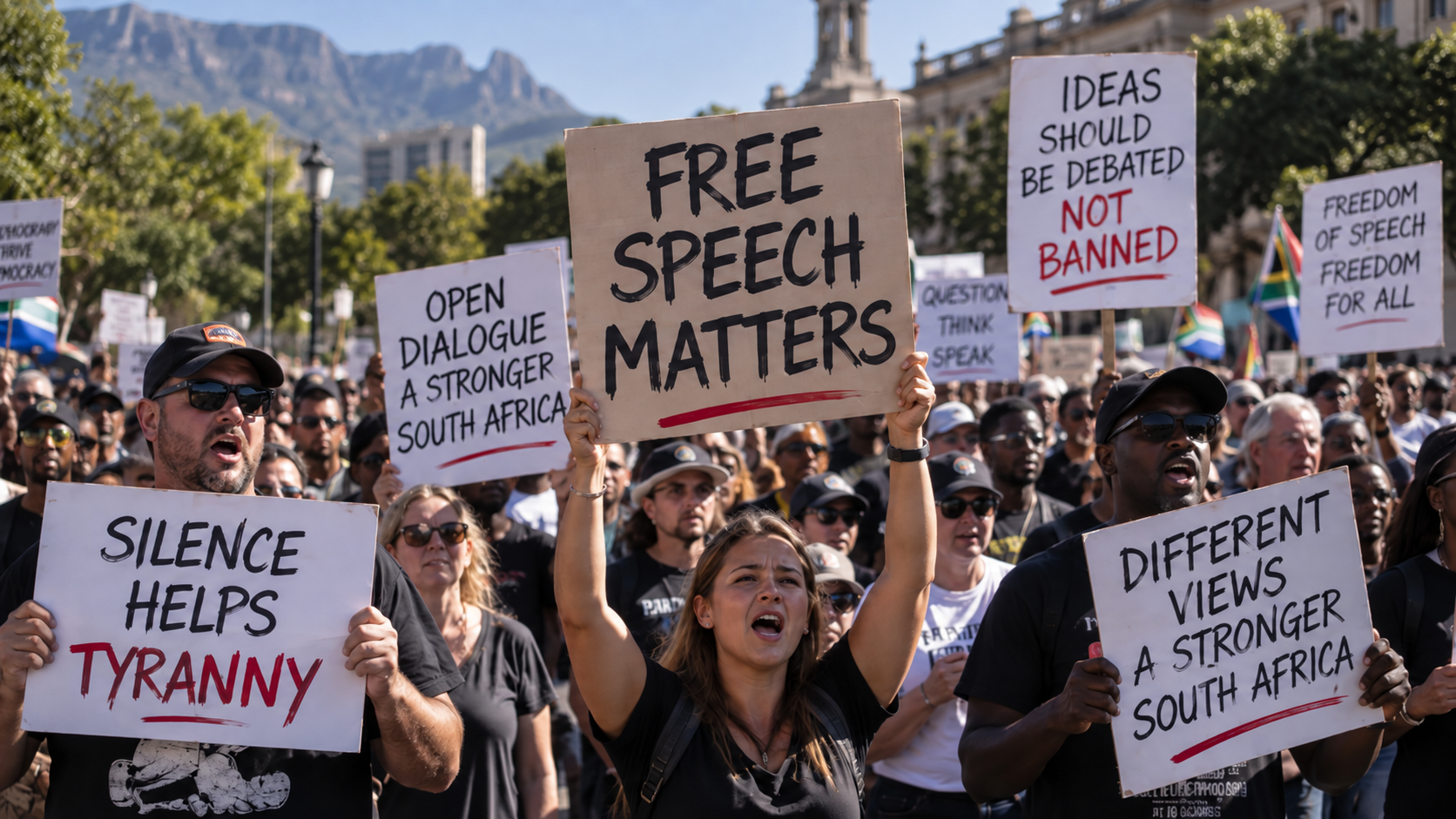
The Free Market Foundation (FMF) relaunched the Free Speech Union of South Africa (FSU SA) at a ceremony held yesterday, 27 May, at Northwards House in Johannesburg. The FSU SA joins a growing international network of free speech organisations committed to defending the free and peaceful expression of ideas, opinions, and beliefs.
The Free Speech Union was first launched in the United Kingdom by Toby Young in 2020 and has since done remarkable work defending people who have been hounded, censured, punished, or professionally targeted for the lawful exercise of their right to express themselves. The success of that project has inspired the formation of similar organisations around the world, now operating under the auspices of Free Speech Union International, including in Canada, Australia, New Zealand, and South Africa.
Adv Mark Oppenheimer, Executive Director of the FSU SA, says:
“Free speech is not merely one right among many. It is the foundation of any open democracy. Without free speech, we cannot discover what is true, test ideas, hold the powerful to account, or participate meaningfully as informed citizens.”
The FSU SA pays tribute to Sara Gon, who played an important role in forming the organisation locally.
“We are deeply grateful for Sara Gon’s efforts in fighting for free speech in South Africa. We at the Free Market Foundation are honoured to continue that work and to build an organisation capable of defending this foundational liberty in the years ahead,” says David Ansara, CEO of the FMF.
The FSU SA will act as an advocacy organisation, championing freedom of expression in public life, universities, workplaces, civil society, and the courts. It will also play an important role in litigation, including by acting as a friend of the court in suitable cases and, where appropriate and financially feasible, assisting individuals who are unfairly victimised for the mere expression of their views.
Oppenheimer emphasises that free speech is most important precisely when views are unpopular, uncomfortable, or offensive to prevailing orthodoxies.
“Throughout history, those who challenged popular orthodoxies were often condemned in their own time. Those who fought for the abolition of slavery, for the end of apartheid, and for the legal recognition of gay marriage all expressed views that many in society once regarded as offensive, dangerous, or unacceptable. Progress depends on the ability to speak, argue, persuade, and reason freely.”
The organisation will also seek to bring leading free speech thinkers, lawyers, writers, and public intellectuals into conversation with South Africans.
“We are delighted to have access to a network of prominent free speech intellectuals around the world, and we hope to share their wisdom with South Africans in the years to come,” says Oppenheimer.
The FSU SA will rely on public and institutional support to carry out its work.
“The price of freedom is constant vigilance. But the price of running a civil society organisation is paid in rands and cents,” concludes Ansara. “If you care about free speech, we encourage you to support and donate to this cause.”